
A re-examination of the Stinney case began in 2004, and several individuals and Northeastern University School of Law sought a judicial review. His conviction was overturned in 2014, 70 years after he was executed when a court ruled that he had not received a fair trial.
Incident
In 1944, on either March 24 or 25, the bodies of two young girls, Betty June Binniker (1933–1944), age 11, and Mary Emma Thames, age 7, both white, were discovered in Alcolu, South Carolina. The girls had gone missing the day prior, as they never returned home the previous night.Binniker had died as the result of head trauma, her skull having been fractured

Arrest and prosecution
Police arrested 14-year-old George Stinney as a suspect. They stated that he had confessed to the crime while under custody.There was a written record of his confession in the form of notes provided by an investigating deputy.
No transcript was recorded of the brief trial. Stinney was convicted of first-degree murder of the two girls in less than 10 minutes by an all-white jury, during a two hour trial.The court refused to hear his appeal. He was executed that year, still age 14, by electric chair.
In the decades since Stinney’s conviction and execution, the question of his guilt, the validity of his reported confession, and the judicial process leading to his execution have been extensively criticized.
A group of lawyers and activists investigated the Stinney case on behalf of his family. In 2013, the family petitioned for a new trial. On December 17, 2014, his conviction was posthumously vacated 70 years after his execution, because the circuit court judge ruled that he had not been given a fair trial; he had no effective defense representation and his Sixth Amendment rights had been violated. The judgment noted that while Stinney could have committed the crime, the prosecution and trial were fundamentally flawed. Judge Mullen ruled that his confession was likely coerced and thus inadmissible. She also found that the execution of a 14-year-old constituted “cruel and unusual punishment.”
Case background
In 1944, George Junius Stinney, Jr. lived in Alcolu, Clarendon County, South Carolina. The 14-year-old lived with his father, George Stinney Sr., mother Aimé, brothers John, 17, and Charles, 12, and sisters Katherine, 10, and Aimé, 7. George Sr. worked at the town’s sawmill, and the family resided in company housing. Alcolu was a small, working-class mill town, where white and black neighborhoods were separated by railroad tracks. The town was typical of small Southern towns of the time. Given segregated schools and churches for white and black residents, there was limited interaction between them.
The bodies of Betty June Binnicker, age 11, and Mary Emma Thames, age 7, were found in a ditch on March 23, 1944, on the African American side of Alcolu, during a search after they had not returned home the night before. George Stinney Sr. helped in the search. The girls had been beaten with a weapon, variously reported as a piece of blunt metal or a railroad spike. The girls were last seen riding their bicycles looking for flowers.
As they passed the Stinneys’ property, they had asked young George Stinney and his sister, Aimé, if they knew where to find “maypops”, a local name for passionflowers. According to Aimé, she was with George at the time the police later established for the murders.
According to an article reported by the wire services on March 24, 1944, and published widely, with the mistake of the boy’s name preserved, the sheriff announced the arrest and said that “George Junius” had confessed and led officers to “a hidden piece of iron.”Both girls had suffered blunt force trauma to the face and head.
Reports differed as to what kind of weapon had been used. According to a report by the medical examiner, these wounds had been “inflicted by a blunt instrument with a round head, about the size of a hammer.” Both girls’ skulls were punctured. The medical examiner reported no evidence of sexual assault to the younger girl, though the genitalia of the older girl were slightly hurt.
Investigation
George Stinney and his older brother Johnny were arrested on suspicion of murdering the girls. Johnny was released by police, but George was held. He was not allowed to see his parents until after his trial and conviction. According to a handwritten statement, the arresting officer was H.S. Newman, a Clarendon County deputy, who stated, “I arrested a boy by the name of George Stinney. He then made a confession and told me where to find a piece of iron about 15 inches were [sic] he said he put it in a ditch about six feet from the bicycle.” No confession statement signed by Stinney is known to exist. The 14 year old claimed that the arresting officers starved him and then bribed him with food to confess.
George was reported to have gotten into fights at school, including a fight where he scratched a girl with a knife. This assertion by Stinney’s seventh-grade teacher, who was African American, was disputed by Aime Stinney Ruffner when it was reported in 1995. A local white woman who remembered Stinney from childhood said in 2014 that Stinney had threatened to kill her and her friend the day before the murder, and that he was known as a bully.
Following George’s arrest, his father was fired from his job at the local sawmill, and the Stinney family had to immediately vacate their company housing. The family feared for their safety. His parents did not see George again before the trial. He had no support during his 81-day confinement and trial; he was detained at a jail in Columbia 50 miles from Alcolu, due to the risk of lynching. Stinney was questioned alone, without his parents or an attorney. Although the Sixth Amendment guarantees legal counsel, it was not until 1963 Gideon v. Wainwright that explicitly required representation through the course of criminal proceedings.
Trial
The entire proceeding against Stinney, including jury selection, took one day. Stinney’s court-appointed defense counsel was Charles Plowden, a tax commissioner campaigning for election to local office. Plowden did not challenge the three police officers who testified that Stinney confessed to the two murders, despite this being the only evidence against him.
He did not challenge the prosecution’s presentation of two differing versions of Stinney’s verbal confession. In one version, Stinney was attacked by the girls after he tried to help one girl who had fallen in the ditch, and he killed them in self defense. In the other version, he had followed the girls, first attacking Mary Emma and then Betty June. There was no physical evidence linking him to the murders. There is no written record of Stinney’s confession apart from Deputy Newman’s statement.
Stinney’s trial had an all-white jury, as was typical at the time. As most Black people were still disenfranchised and prohibited from voting, they could not be selected as jurors. More than 1,000 whites crowded the courtroom, but no Black people were allowed.
Other than the testimony of the three police officers, at trial prosecutors called three witnesses: Reverend Francis Batson, who discovered the bodies of the two girls, and the two doctors who performed the post-mortem examination. Conflicting confessions were reported to have been offered by the prosecution. The court allowed discussion of the “possibility” of rape although the medical examiner’s report had no evidence to support this. Stinney’s counsel did not call any witnesses, did not cross-examine witnesses, and offered little or no defense. The trial presentation lasted two and a half hours.
The jury took less than ten minutes to deliberate, after which they returned with a guilty verdict. Judge Philip H. Stoll sentenced Stinney to death by electrocution. There is no transcript of the trial. No appeal was filed by his defense attorney.
Stinney’s family, churches, and the NAACP appealed to Governor Olin D. Johnston for clemency, given the age of the boy. Others urged the governor to let the execution proceed, which he did. Johnston wrote in a response to one appeal for clemency:
It may be interesting for you to know that Stinney killed the smaller girl to rape the larger one. Then he killed the larger girl and raped her dead body. Twenty minutes later he returned and attempted to rape her again, but her body was too cold. All of this he admitted himself.
Between the time of Stinney’s arrest and his execution, Stinney’s parents were allowed to see him once, after the trial when he was held in the Columbia penitentiary. Under the threat of lynching, they were not allowed to see him any other time.
Execution
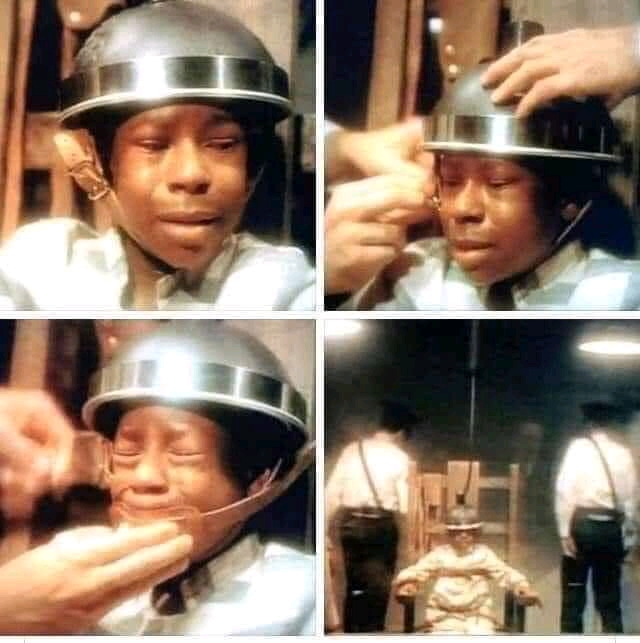
Standing 5 feet 1 inch tall and weighing just over 90 lbs, George Stinney was executed at the Central Correctional Institution in Columbia, South Carolina on June 16, 1944, at 7:30 p.m. He was prepared for execution by electric chair, using a Bible as a booster seat because George was too small for the chair. George was then restrained by his arms, legs, and body to the chair. The executioner placed the face mask over his face, which did not fit him. When the lethal electricity was applied, the mask covering George’s face slipped off, revealing tears streaming down his face. He was buried in an unmarked grave in Sumter, South Carolina.
Source : Wikipedia



 THE STARKING
Leave a comment